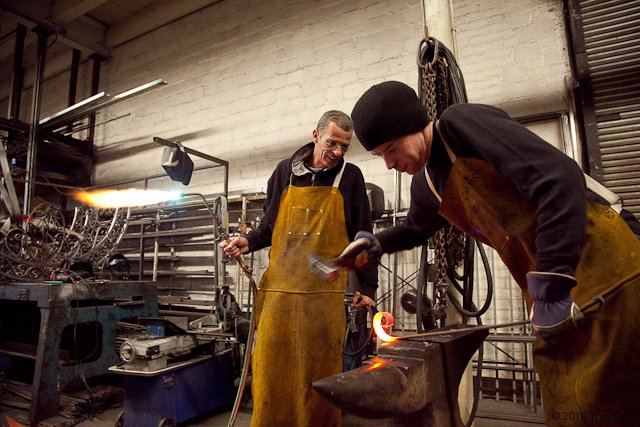
Carlos Nielbock: Metalsmith

16 November, 2010: Carlos Nielbock: CAN Art Handworks, Inc.

Detroit. CAN Art Handworks is located a few blocks off downtown’s Eastern Market, but seems a world away from what we’d consider an urban environment. Because the majority of the buildings in this neighborhood have been cleared off, the place feels more like farmland than the industrial region it is known as. Trees and fields of lush grass stretch to the horizon, punctuated by the occasional brick building or workman-style home. There is a surreal beauty to this, the disproportionate verticalness of the structures accentuated by what feels like farmland. When an SUV streaks through this field of green, on a street unseen from my vantage point, I imagine what an aerial view of this neighborhood must look like: a net of black asphalt resisting in vain this incessant carpet of nature. At this rate of industrial decay, I wonder how long would it take for all evidence of man to be erased.

The address I have for Carlos Nielbock has brought me to one of these anomalous buildings. Though the monolithic structure itself is unmarked, the lot adjoining it is fenced in ornate wrought iron with grand gate work. Above this gate are the words CAN Art Handworks rendered in a classical font suggestive of the Old World.

The building is a fortress. The first story is impenetrable from the street, save for the blank metal security door I’m standing at. I ring a doorbell placed high on the wall, and I realize I’m under video surveillance. In fact, from where the cameras are mounted, it seems the entire street is under surveillance.

The door opens, and I’m escorted into the fortress by a thin guy dressed in black work clothes and welding gear, a cigarette hanging from his lips. This is Eric, a hired hand, and he asks me about my project with a peculiar interest. He leads me up three flights of stairs to a wooden door, where he knocks and excuses himself for the work going on below. I wait. From a window I get a better view of the neighborhood. I can see the streets between the fields, closer to what I imagined at ground level.

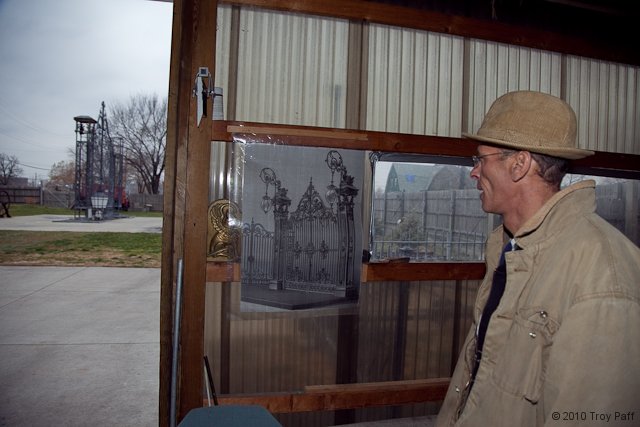
Carlos welcomes me into his home with a strong handshake. Of German origin, he’s a rangy, middle-aged sort, square shouldered and lean, with sharp blue eyes. From behind his pair of minimalist spectacles I get an immediate sense of scrutiny. It is directed at me.

Carlos lives on this upper floor of the building. It is a dark and moody loft with dramatic directional light and lots of wood. The ceilings are high and beamed, and the walls are adorned with fantastic metal fabrications of regal crests and elegant fixtures. All around the place are fine examples of African tribal sculpture, all rendered in crude metal. With its open floor plan and attention to detail, it’s a hell of a bachelor pad.

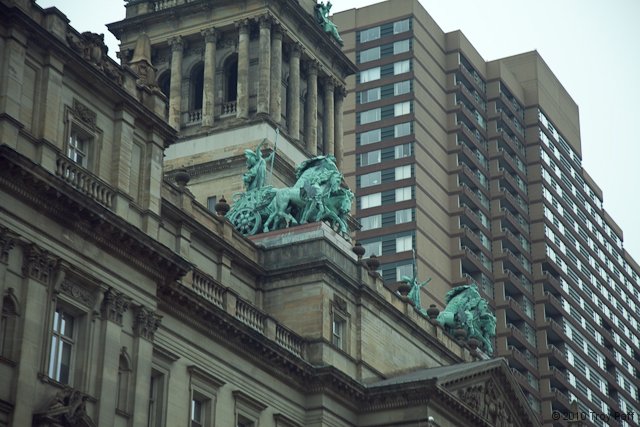
Cigar in hand, Carlos conducts a tour of the building proper. Beginning on the second floor, I am shown archives of his work from the past thirty years in Detroit. I learn that he’s the go-to guy for metal restoration in all of the city, and he’s had his hands in nearly every historic renovation that’s been done here. He’s worked on classic buildings and sculptures designed by regarded architects and artists, creative work that would have fallen by the wayside if not for an acute attention to craft and the classical ways of working with particular metals.

Out in the yard, dodging Rottweilers that Carlos reprimands in German (“This is Detroit,” he reminds me), he explains his ongoing project of the last twenty years. It is a creation of a gate design from the World Exhibition of 1862, crafted in increments as time and resources permit. While the framework is 90% complete, the details will likely take decades more to finish. This project, Carlos explains, will be a masterwork for the ages, a one-of-a-kind achievement never before realized, the scope of which will never be undertaken again. I must admit, it is remarkable. Here in the neighborhood, it is already a monument– albeit a surreal one.

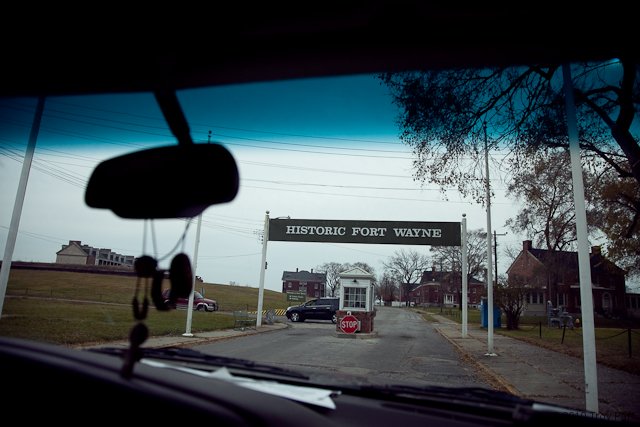
Carlos takes us off the premises, in his pickup. Besides the various architectural landmarks downtown, there is one particular destination he wants me to experience. Historic Fort Wayne was completed in 1851 to defend against possible aggression from the British. It was later fortified in 1861 during the Civil War, but never saw battle. It served as a garrison and mustering center during both World Wars, as well as the Korean War and Vietnam. It housed anti-aircraft weaponry and missiles during the Cold War. Now it exists as a historical park and reserve, but due to budgetary issues and a flagging population, it is challenged with disrepair. Because of the fort’s need for help, and because of his passion for historic preservation, a collaborative agreement was reached allowing Carlos to utilize otherwise dilapidated space as a living museum for Detroit’s architectural history and restoration. On the grounds and in several of the fort’s outbuildings Carlos maintains and exhibits artifacts such as the bell and clockworks from the original city hall clock tower, saved from destruction via bureaucratic process and no shortage of legal red tape. Also on display is the ironwork of the old Fort armaments, massive cannons that are in immaculate condition thanks to Carlos’ efforts. Trouble is, the timber components of the guns are long gone. While he has obtained authentic plans and permission to rebuild the cannons to spec, the cost involved in acquiring the materials and completing fabrication is a challenge. He longs for the day when the cannons might again fire cannonballs. “There are few places in the world with this kind of authenticity, and we have the know-how to do this right.” With the possibility of attracting financial assistance from interests involved in historic preservation, Carlos donates his time to outreach through educational pursuits. During the warm months, when foot traffic at the fort increases, Carlos conducts workshops on Old World blacksmithing replete with coal burning foundry and classic handwork.

Driving around Detroit, we discuss the city’s relevance and contradictions. Per capita, it has the highest population of blacks of any city in the United States. Despite this, the city is devoid of monuments to African Americans, instead celebrating a litany of famous whites with statues and murals. We speak of a legacy of political corruption and racism, and the city’s reputation as the most segregated in our country. These motivations drive Carlos with a resolve to not only honor the civil rights heroes of the region, but to work with other artisans, both black and white, on the development of potential monuments celebrating civil rights.

Back at the foundry, Carlos spends time on one of his paid projects, a multi-faceted free-standing trellis for an estate in the suburbs. I’m struck with the elegant simplicity of the design, spirals and florets intertwining in intricate combinations. The proportions are just right, it seems. This is the kind of project that pays the bills, and by bringing revenue from the affluent suburbs into metro Detroit, makes CAN Art Handworks an exception to the trend of the past few decades. On this job, Carlos has Eric on the payroll. Eric is a 24 year-old sculptor with a fascination for metalwork, and has been learning the craft for a few years. Eric tells me in confidence that no one he’s met– in Detroit or New York– has the skills Carlos possesses, and he’s fortunate to learn from a master. Also on hand is a young man from the neighborhood, ShiRay. Learning from Eric, he’s just beginning an exploration of the craft. Carlos tells me (in confidence), that both kids have the core to become excellent, and for that he’s thankful to have them around.

Over a German coffee up in the loft, I learn of Carlos’ personal history. Born in Celle, Germany to a white German mother, he tracked down his African-American father when he reached his early twenties. A G.I. in World War II, his father had been a liberator of the concentration camps at the conclusion of the war. Carlos had learned metalworking from his childhood at a monastery in Celle, but found resistance in the German system of the trades. After receiving an invitation from his biological father to visit Detroit, he discovered that his craft as a metalworker was advanced, and found employment easily. He also found his roots, and developed a connection to his biological dad’s Detroit that he proudly identifies with. It is this sense of pride that informs every piece he creates, and guides every plan he makes for this city and his place in it.

Posted in Journal, Portraits, Tradesmen | Tagged , , , , | 4 Comments

Bethany Shorb: Designer/Printmaker

15 November, 2010: Bethany Shorb: Cyberoptix Tie Lab

Detroit. My first shoot in Detroit takes me to Gratiot Street, not far from Eastern Market. I park my car on a service street behind a row of rough-looking industrial buildings, but, as I zero in on the addresses, I realize that some care has been taken here to beautify and personalize the private entryways to points beyond: new security doors, painted trim, even some house plants on window sills. This is still very much an alleyway environment, but evidence shows that the former industrial purpose has been softened a bit. There also exists the tell-tale sign of youthful presence: hints of stylized community art ranging from selective murals and tiny graffiti to clever placement of stickers touting bands and upcoming events.

I press the button for 2A. A buzzer sounds, and a click releases the door lock. I am no sooner inside the landing when the mailman yells up from the sidewalk, asking me to hold the heavy security door open for him. I oblige and take it one step further by gathering up Bethany’s mail for her.

I walk the stairs to the second floor. The stairwell is massive. Iron and heavy, not even the century that has passed since it’s construction has had an effect on it’s functionality. I glance up the dozen or so floors of the stairwell beyond bicycles, ladders, and dust. While a good cleaning would do the building wonders, this is the kind of place that may last forever if a roof is kept overhead. This is a testament to the workmanship of the industrial age, and where vacancies are concerned, Detroit is littered with this kind of building in startling numbers. Bethany greets me at the third landing. She’s got another security door propped open, a white sign with a large black “2” across the front– very industrial. I deliver her mail.

I met Bethany the month before, at the screening of Detroit Lives. She was featured in the film, and was effective at explaining the influx of young talent to the city. We had exchanged information then, and through Facebook I had learned more about her professional association with Omnicorp and Jeff Sturges. I had also learned about her screen printing and textile business here on Gratiot Street: Cyberoptix Tie Lab, a web-based storefront for custom, one-of-a-kind, hand-screened neckties and scarves.

Bethany has been in New York City for the weekend. It’s Monday, and she is behind on filling orders. She makes a few phone calls to bring in her helpers, those necessary hands required to maintain an efficient workflow. As Bethany preps for a long day of production, I explore her studio: it’s a cool loft with high ceilings, and examples of her art and interests fill walls and corners and personify her expression. It is evident that Bethany is involved in music as well as the visual arts, and her appreciation for vintage artifacts serves her proclivity for dark themes. At the same time, Bethany is the epitome of modern. Evidence of creative re-use abounds; she is as much a re-inventor as she is an artist.

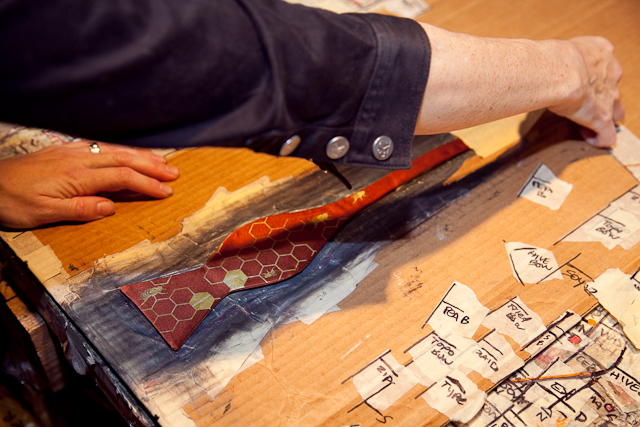
Cyberoptix has been in operation since 2006, after Bethany had developed an online reputation for costume design and wardrobe construction for art installations and underground music groups like Skinny Puppy. When inquiries for a particular tie design (involving a gas mask motif) took off, a sideline project evolved into what is now Bethany’s bread-and-butter moneymaker. Whereas the first ties were hand painted, the current styles are screen printed for better control, quality, and durability.

Bethany’s designs are entirely original. They project her appreciation for irony with clever concepts (ie., “Terminal Illness” graphically combines a microscopic representation of a flu virus with floor plans of the world’s airports) and succeed with their surprising elegance. Orders are gathered from her own web site as well as an artisan storefront web site called Etsy. Every order is made to spec, by hand, by Bethany. She’s constantly monitoring the computer, pulling blank tie stock, mixing colors, masking her screens for runs of anywhere from dozens to but a single tie. Her clientele runs the gamut from working class stiff to the newly betrothed to the corner office, executive level professional. Lawyers and doctors are particularly faithful customers, and often the targeted recipients of gifts ordered by the well-meaning relatives that love them.

Bethany shows me a photograph on her computer. It’s an image of several elderly gentlemen standing shoulder to shoulder in an email she received last week. She points out the necktie worn by the man in the center, one of her own. It features circles and squares of varying sizes, lines and groups of boxes in an exciting yet beautiful array. “Nice design,” I say. “Who are these guys?”

“That’s General Tom Stafford, commander and pilot of the Apollo 10 mission.” She put a tie with the same design into my hand, and pointed out the print. “This design is adapted from the control panel layout of the Lunar lander’s cockpit. Seems someone found my tie online, and made a gift to the general. Now all the Apollo astronauts want one. How cool is that?” I agree. If it’s the little affirmations that mean a lot, then Bethany and Cyberoptix should have enough to last a lifetime.

Over the course of the afternoon and into the evening, Bethany and her three assistants keep the assembly line moving. While Bethany does all of the screen printing herself, one assistant irons tie and scarf stock flat before she can apply the ink. Another keeps the screens clean and dry– a task made more challenging due to her use of non-toxic inks, as they dry fast and can gum up a screen if not washed promptly. Her third associate packages the finished product, wrapping and hand tying each bundle. For an additional fee, a sleek wooden gift box can be used. As the day progresses, hundreds of ties are printed and packaged.

It’s sunset, and I look out the window at the downtown skyline. So many buildings are empty, and the city is surprisingly quiet. Some might call it dead. Bethany could be operating her business anywhere, so why Detroit? Because of the economic blight here, Bethany does get a great deal on rent. But, more than that, she embraces the city that has been formative for her since graduating from Cranbrook Academy of Art way back in 2001. At that time she considered moving back to the east coast, where she was born, but the relationships she’d formed in college suggested a continuation of her efforts here. Participation in a new art and music scene was exciting, and a degree of pride and ownership in that scene made her reconsider the exodus chosen by most graduates at that time. Feeling that Detroit was at its lowest back then, anything to come from the ashes would be a positive that Bethany wanted to be a part of. Now that the rest of the country has caught up with the bottoming out, Detroit’s reputation as the country’s catastrophe has taken an interesting turn, one that’s only beginning to get press. Because of spaces like hers and the freedom from the economic restrictions prevalent in every other city in this country, Detroit represents a tremendous opportunity for the hungry artisan, and their numbers are expanding. “You can have so much here, for so little. I can’t imagine giving up the advantage I experience here in Detroit for another city, even New York. I love it here.”

Posted in Journal, Portraits, Tradesmen | Tagged , , , , , | 1 Comment

13 November, 2010

Detroit, Michigan. I venture downtown to Eastern Market with my dad, where I meet with Jeff Sturges. He’s a founding member of OmniCorp Detroit, which is described on their website as such:

OmniCorpDetroit is an intense group of designers, artists, engineers, musicians, thinkers, do-ers and makers that get together to build new things as well as share and collaborate within the Detroit community. In general, we’re making, breaking, reshaping and hacking all sorts of things!

I learned about OCD in September, when I visited Detroit to assess firsthand the urban decay brought on by our Great Recession (and more specifically by the demise of the auto industry), and to scout for this project. That day had coincided with the premiere of a short documentary called Detroit Lives, featuring the Jack Ass franchise’s Johnny Knoxville on a beat to explore the city for similar reasons. While the film points out the decimated state of the city replete with the ‘ruin porn’ that has given D-Town a new kind of fame, it also introduces a new wave of young talent that is moving here. These urban immigrants are artisans, technicians, innovators, and educators, and they are working in collaborative circles to maximize resources and to support one another in creating a sustainable community based on self reliance.

As Jeff explains, there exists here a tremendous opportunity to take advantage of low overhead and relaxed regulation to do what you want and on your own terms. The potential for this kind of production to affect community is already apparent, with collaborative efforts with schools, churches, and neighborhoods already gaining in momentum. Tech workshops involving electronics, computers, salvage, and basic fabrication teaches a resourcefulness that our urban communities can use. As he and his growing team of co-operative artisans work to convert an old produce storage facility into a productive studio environment, it occurs to me that this may well be ground zero for the future of development and manufacturing in Detroit, if not the country as a whole. I am surrounded by a new kind of tradesman. Jeff passes along a handful of names of industrious folk who fit the description of my project.

Posted in Journal | Leave a comment